The quick answer
Budget housing, the animal and feed separately. Build a Silo before relying on stored hay, feed animals daily, and remember that Deluxe auto-feeding still needs hay in storage. Pigs require a Deluxe Barn and do not find truffles in winter or rain.
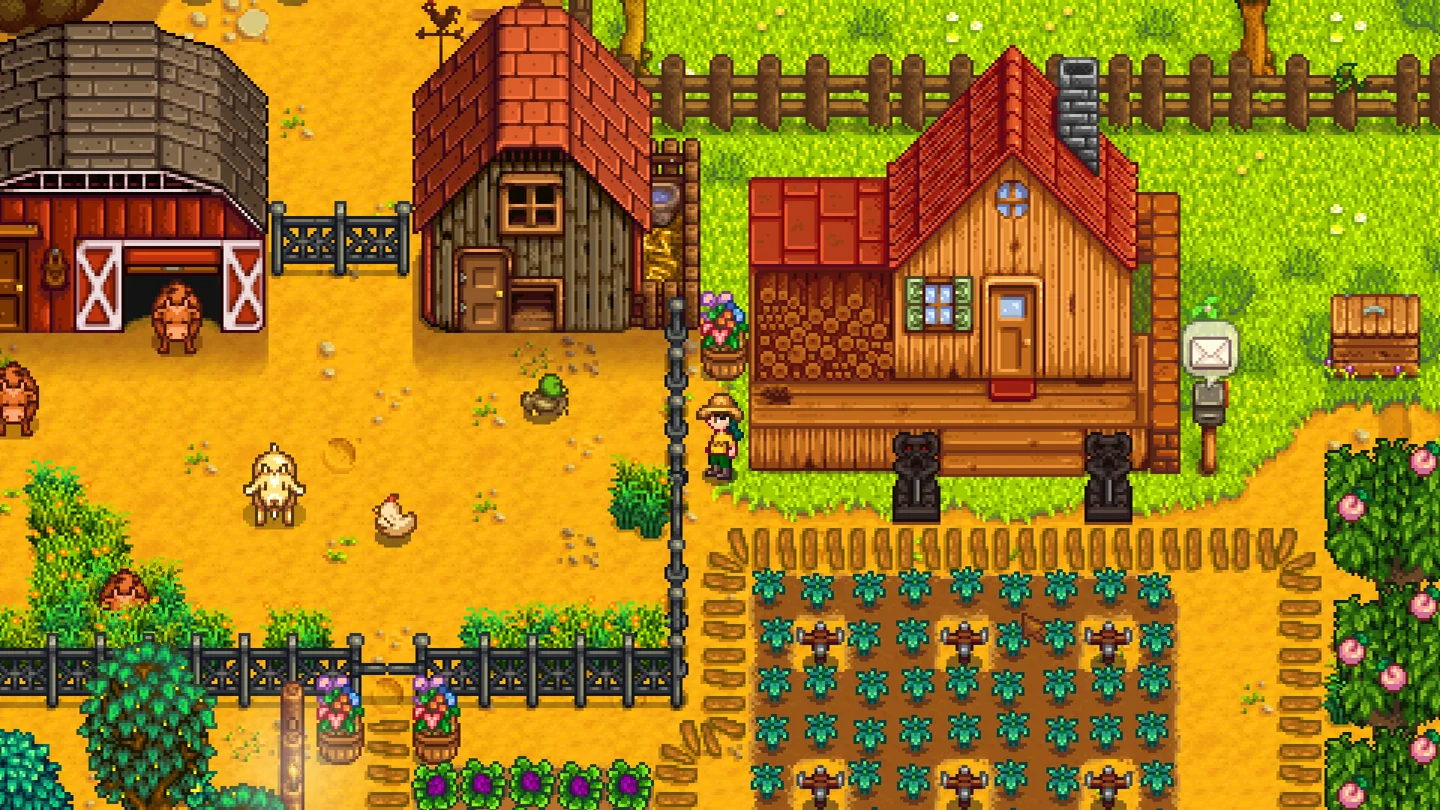
Treat housing and daily care as one project
Buying an animal is only part of starting an animal business. You need suitable housing, a daily feeding arrangement, room for the animal’s production and money left for the rest of the farm. An impressive building that leaves you unable to maintain its occupants is a poor first expansion.
Choose the product or bundle requirement you are working toward before ordering an upgrade. Chickens begin in a basic Coop, while Ducks need a Big Coop and Rabbits need a Deluxe Coop. Pigs need a Deluxe Barn. The correct building tier matters more than its empty capacity.
Housing costs by upgrade step
| Building step | Gold | Wood | Stone | Capacity after the step |
|---|---|---|---|---|
| Coop | 4,000g | 300 | 100 | 4 |
| Big Coop upgrade | 10,000g | 400 | 150 | 8 |
| Deluxe Coop upgrade | 20,000g | 500 | 200 | 12 |
| Barn | 6,000g | 350 | 150 | 4 |
| Big Barn upgrade | 12,000g | 450 | 200 | 8 |
| Deluxe Barn upgrade | 25,000g | 550 | 300 | 12 |
These are incremental costs. A fresh basic Barn followed by both upgrades totals 43,000g, 1,350 Wood and 650 Stone before buying animals. The equivalent full Coop chain totals 34,000g, 1,200 Wood and 450 Stone. Do not read the Deluxe row as a single purchase from an empty plot.
Capacity is the finished tier’s total, not an extra number added to the previous tier. A Deluxe Coop holds 12 animals altogether, rather than 4 + 8 + 12.
Put a Silo into the feed plan
A Silo costs 100g, 100 Stone, 10 Clay and 5 Copper Bars. It takes two days to build and stores up to 240 Hay. Stored hay is accessible through animal-building hoppers regardless of how close the Silo is to that building.
Check storage before clearing large amounts of grass. A feeding plan needs actual stored hay or accessible grazing, not just a Silo standing on the farm. If the storage is empty, an auto-feeder cannot create feed.
Use an animal’s occupied days as a basic hay budget when grazing will not be available. Four animals over 28 fully hay-fed days need 112 Hay. Twelve animals over the same period need 336, which exceeds one 240-Hay Silo. This is a planning calculation assuming one hay per animal per feeding day; arrival-day exceptions and grazing can reduce use.
A daily routine that scales
Check feed and water the crops first according to your usual route, then visit each animal building. Pet animals, collect available products and verify whether the animals can graze. On rainy days and in winter, plan around indoor feeding rather than assuming outdoor grass will cover the day.
Basic and Big buildings need you to put available hay onto the feeding bench. Deluxe buildings add an auto-feeding system, provided hay is stored. Upgrading saves part of the routine; it does not remove the need to inspect supply.
In 1.6, grass can persist through winter, so the old claim that every grass tile disappears on Winter 1 is outdated. That does not make winter grazing a replacement for a hay reserve. Animals remain indoors during winter, and winter grass behaves differently from its growing-season spread.
Why an animal is not producing
First check maturity. A newly purchased baby is not an immediately productive adult, and an unfed young animal does not keep growing normally. Next check food, mood, friendship and the product’s schedule. Not every animal produces the same item every single morning.
Hungry animals do not simply die from missing a feed, but they become unhappy and can stop producing. Fix the daily care problem before buying more animals. An empty bench and a full hopper indicate a different issue from an empty Silo.
Large animal products are not guaranteed just because the building is upgraded. Care and friendship matter. For the standard Animal Bundle, inspect the five-of-six choice rather than assuming you must obtain every offered product before the room can progress.
Plan Pigs around the weather and season
A Pig costs 16,000g and requires a Deluxe Barn. Truffles depend on an adult Pig being able to go outside; rain and winter prevent that ordinary outdoor production. Buying a Pig near winter is therefore not a promise of immediate daily truffle income.
Before investing, add the building chain, animal cost and feeding reserve to the same budget. If that leaves the farm unable to buy seasonal seeds or finish a nearer unlock, build the supply base first.
Animal goods also feed the Community Center route. Once the daily care is reliable, compare crop processing as a separate income branch rather than expanding every system simultaneously.
More help with crafting & progression across our game guides.